Colliery Tours
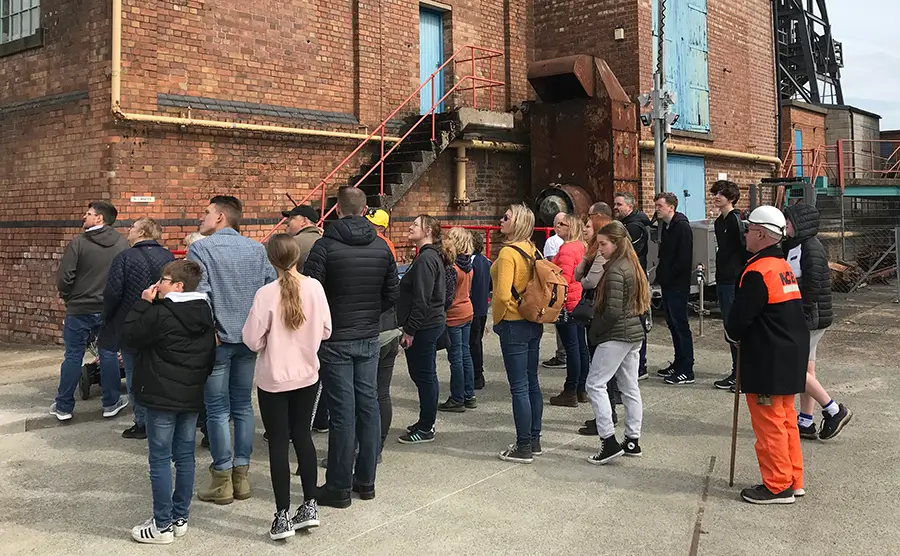
Throughout the year we provide a programme of colliery tours led by former coalminers and re−enactors. The tour of the surviving historic buildings tells the story of Snibston Colliery from its beginning in the 1830’s to its closure in the 1980s.
Upcoming events
April 2026
- Sunday 12th April
- Saturday 25th April
May 2026
- Sunday 10th May
- Saturday 23rd May
June 2026
- Sunday 7th June
- Saturday 20th June
July 2026
- Sunday 5th July
- Saturday 18th July
August 2026
- Sunday 2nd August
- Saturday 22nd August
September 2026
- Sunday 6th September
- Saturday 19th September
October 2026
- Sunday 4th October
- Saturday 17th October
- Friday 30th October
- Saturday 31st October
November 2026
- Sunday 15th November
- Saturday 28th November
December 2026
- Sunday 13th December
What to expect on your visit
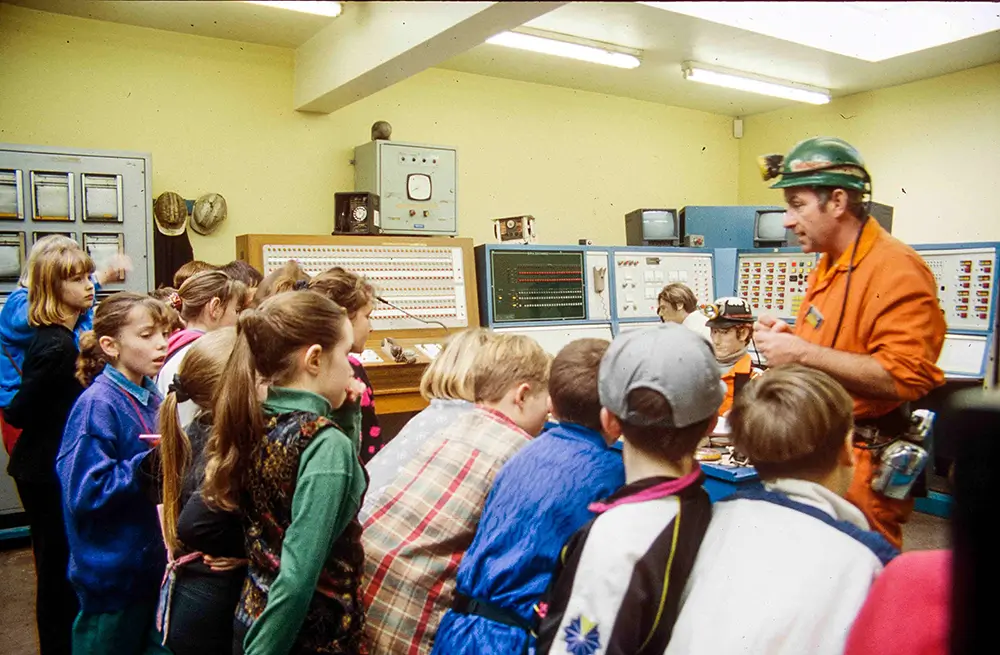
Snibston Colliery is a very important historic site – a ‘Super Pit’ once turning over 1,000,000 tons of coal a year – with unique site buildings that cannot be seen at any other British coal mine. The tour will take you through a mine machinery display, inside the colliery to the 1970’s Control Room, and the Lamp Room where the miner collected his electric cap lamp and his respirator and, if he was a Deputy, his flame safety lamp.
You will then visit the miners’ favourite and least favourite rooms. The Pay Hall where he received his pay packet, and the dreaded Medical Centre, where the colliery Nurse reigned supreme. Once outside the guide will take you to The Cage where miners would descend the 900 feet (275 metres) into the mine, followed by the Winding Engine House and the explosive Powder Store.
For college or University visits see Group Tours.
- Each tour is about 1½ hours, and all tours start and finish at the Colliery Café.
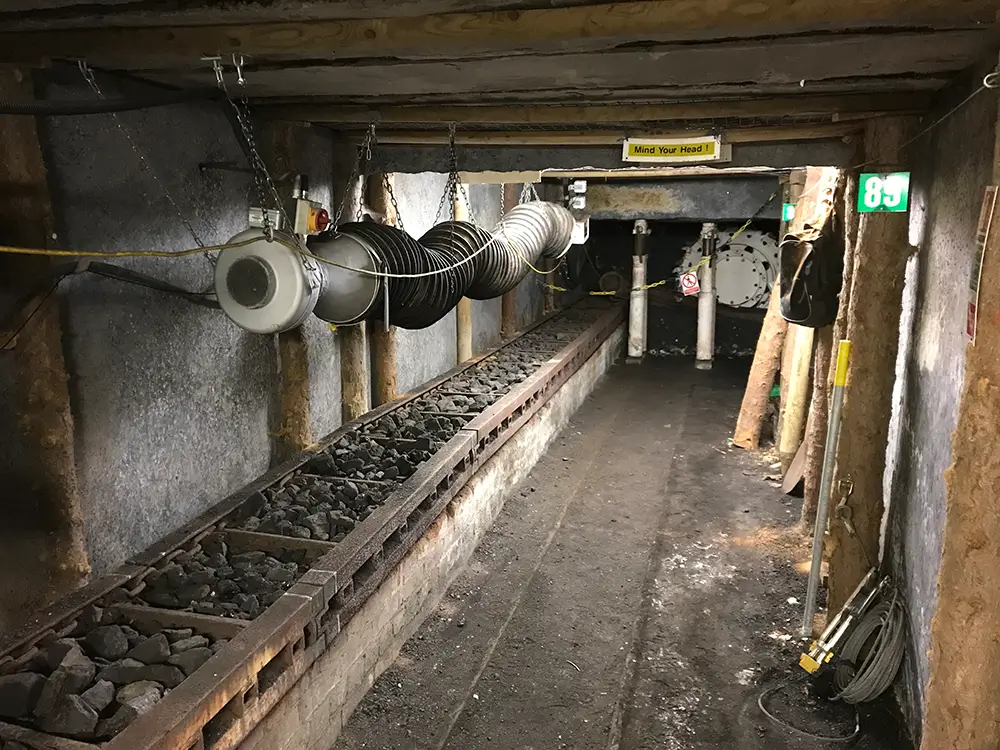
'Into the Dark' mine simulation
As it is no longer possible to go underground at Snibston, you can experience our ‘Into the Dark’ mine simulation. An accurate recreation of a coalface at Snibston which gives you the experience of being underground without leaving the surface.
How do I book a free ticket for my child/children under 15?
You don’t need to. Just turn up with your child/children. They are all welcome.
Are there any steps on the tour?
Yes, there are 14 steps up onto the Pit Top and 5 up to the Winding Engine House. If you have some mobility issues our tour assistant can help you negotiate the steps. If you have very limited mobility the assistant will explain the Pit Top and Winding Engine House from the bottom of the steps.
Do I need to wear heavy boots/shoes?
No, the tour is on solid ground, but a pair of comfortable shoes are recommended.
Are there any loud noises?
Yes. There will be a loud bang in the explosive store. Please let the guide know if you or any of your party have noise issues and the guide will let you know when the bang will occur. There are also moderately loud bell sounds in the pit top and winding engine house.
Is it dog friendly?
No, apart from assistance dogs. We suggest your assistance dog is not in the Powder Store during the explosion.
How to find us
We are situated on Ashby Road, Coalville, Leicestershire LE67 3LN. Our what 3 words is afford.army.look.
Coalville is 15mins from junction 22 of the M1 to the south and 15mins from the A42 Ashby turn-off to the north. When using a Sat Nav please following post code LE67 3LN.
Parking
Parking on site is to the right when entering Snibston Colliery Park. The car park is behind the Café. It has an ANPR system, so please pay on exit. Current fees will be displayed at the pay station.
There are disabled bays as well as car charging bays.
Accessibility
Most of the tour is on a flat surface with ramps going into and out of the main building. However due to its size the ‘into the dark’ experience is unsuitable for wheelchair access. Part of the tour is by some 14 then 5 steps. Assistance dogs are welcome but in the powder magazine there is a explosion demo which is unsuitable for dogs.

Facilities on-site
A mountain bike trail, nature reserve and heritage trail can all be found on site with the country’s best preserved colliery site located in the heart of the National Forest.
For general information only. Opening times, events and restrictions may change without notice. Please check each venue’s website or contact them directly before visiting.
Meet the guides and our historical characters
On the colliery tour you will be guided by one of our excellent miners and historic characters from the history of the mine. Not all these guides and historic characters will be at every tour, but you will get to meet a few of them during your visit.

Bryan
Born at Woodville, Bryan worked in a clay mine from 1958 until 1962 when he became bass guitarist for the Casuals. After a few years he left the band and started as a miner at Rawdon Colliery. He later worked at Whitwick Colliery. In 1979 he became a Mine Deputy. These men oversaw the mine on behalf of the Mine Manager and had to understand every aspect of mining. In 1986 when the Leicestershire mines closed, he went to work at Cliffe Hill Quarry.
(Bryan was a Deputy) 

Steve
Born in Burton-Upon-Trent. Steve started work in 1974 at Rawdon Colliery as a trainee coalface worker and later became a Deputy. In 1979 he joined the Leicestershire and South Derbyshire Mines Rescue Team based at Ashby de la Zouch. Mines Rescuers continued to work in the mines but were on call 24 hours in the event of a mine disaster or serious accident. When the Leicestershire mines started to close in the 1980s/90s, he transferred to Cadley Hill Colliery and after redundancy became a long-distance lorry driver.
(Steve was a Deputy)

Dave
Born in 1959, Dave started work at South Leicester Colliery in 1978 as a low voltage underground electrician working mainly on communications.
From late 1979 he worked in the control room, then started winding in 1981 he transferred to Snibston winding in 1983 until he left in 1986 also winding at Asfordby from early 1988 to late 1999 driving the shaft sinking winder for cementation mining.
(Dave was a Winderman)

Alan
Born in Gateshead in the Northeast of England. Alan went to Newcastle University to learn NCB mining engineering. After graduating he became Shift Under Manager at Thoresby Colliery in Nottinghamshire. After leaving the NCB he worked for a mining machinery company, then became a Mine Manager of Hay Royds mine in West Yorkshire and later Mine Manager of Eckington mine in Derbyshire. The Manager is responsible for all aspects of the mine such as production, safety, miners’ welfare, running costs and procurement of mining machinery.
(Alan was a Mine Manager)

Barry
Barry was born in Coalville and after leaving school in 1968 was an apprenticed electrician at Whitwick Colliery. In 1975 he became a fully qualified Class 1 Mine Electrical Engineer. A mine electrician is responsible for ensuring every piece of underground mining and communication equipment which runs on electricity, and that is nearly everything running smoothly and safely. When a machine breaks down, along with the mechanical engineer, he was responsible for getting the machine working again as quickly as possible. When the mines closed, Barry went to work as a pump engineer. 
(Barry was an Electrical Engineer)

Paul
Born in Leicester in 1956 Paul left school at 15. In 1971 after a number of dead-end labouring jobs, he started work at Whitwick Colliery where he trained as a faceworker. In 1975 he started his Deputy training and qualified as a Deputy in just 15 weeks. Paul stayed at Whitwick Colliery until the mine closed in 1986. After being made redundant he was offered a job at Asfordby Mine working for NCB/Budge Mining but refused. He retrained in IT working in retail computer systems.
(Paul is one of our re-enactors)

Sister Susan
At 15 in 1964, Susan enrolled to train as a nurse and spent 2 years as a cadet in an NHS hospital. She qualified 3 years later as a State Enrolled Nurse (SEN). Following this she spent 2 years training as an industrial nurse. After qualifying to work in any industry she chose the National Coal Board. As an industrial trained SEN, she was qualified to carry out any emergency procedure that arose. Once at Snibston she was trained by Mines Rescue and was the only female permitted, by law, to go underground and onto the coalface.
(Sister Susan is one of our re-enactors)

Joseph Saunders
Born a Quaker in 1785 at Mackworth near Derby, at twenty, after public school, Joseph Sandars joined his father in the family corn merchant business. Bread at that time was expensive and corn merchants became very wealthy. In 1805 he moved to Liverpool to open a branch of the family business. In 1824 he was one of the businessmen responsible for the creation of the Liverpool and Manchester Railway and befriended George Stephenson who built the railway. In 1831, along with Sir Josuah Walmsley and George Stephenson, he became a partner in the Snibston Colliery Company, which owned Snibston collieries. He lived at Taplow House in Buckinghamshire.
(Joseph Sandars is one of our re-enactors).

The Colliery Tour Assistants
The tour group will be accompanied by a tour assistant who will be at the rear of the tour helping both the tour guide and group. The assistant will help the group to stay together and will answer any general questions about the tour. They will also assist if a member of the tour feels unwell or needs to sit down.

Sue
Born in Leicester, Sue married a Coalville miner at the age of 22 (in 1940). She moved to Coalville and lived in Mammoth Street. Here she was responsible for housekeeping, shopping, cooking, cleaning, washing clothes and raising their 3 children. It was a tough life and one of the hardest days of the week was wash day as she did not have an electric washing machine, so everything was washed by hand and muscle.
(Sue is one of our re-enactors).